Patient Safety

Safety Is Not an Accident

Hyperbaric oxygen therapy involves elevated pressure and 100% medical-grade oxygen — a combination that demands the highest standards of clinical training, equipment quality, and operational discipline. At Bay Area Hyperbarics, our impeccable safety record over 28 years and more than 100,000 patient treatments is the result of deliberate, sustained commitment to every detail of safe care.

Placeholder Image

Years of operation with an impeccable safety record

Patient treatments completed safely

Years our chamber manufacturer has operated without a single equipment-attributable accident

Serious safety incidents in our clinic's history

Meet our safety director

Safety leadership starts at the top.

Bay Area Hyperbarics is one of very few independent clinics in the country to have a dedicated Safety Director — a role we treat as a clinical necessity, not an administrative title. Our Safety Director personally reviews all safety protocols with our hyperbaric technicians every quarter, ensuring standards are not just documented but practiced.

Safety Director & CHT

W. David Roberts

David is a Certified Hyperbaric Technologist (CHT) — the highest credential in the field — and serves as our full-time Safety Director. In this video, he walks through the specific protocols, training requirements, and equipment standards that keep our patients safe every single day.

His role is unique in the independent clinic space. Most facilities have no equivalent position. Ours is a core part of how we operate.
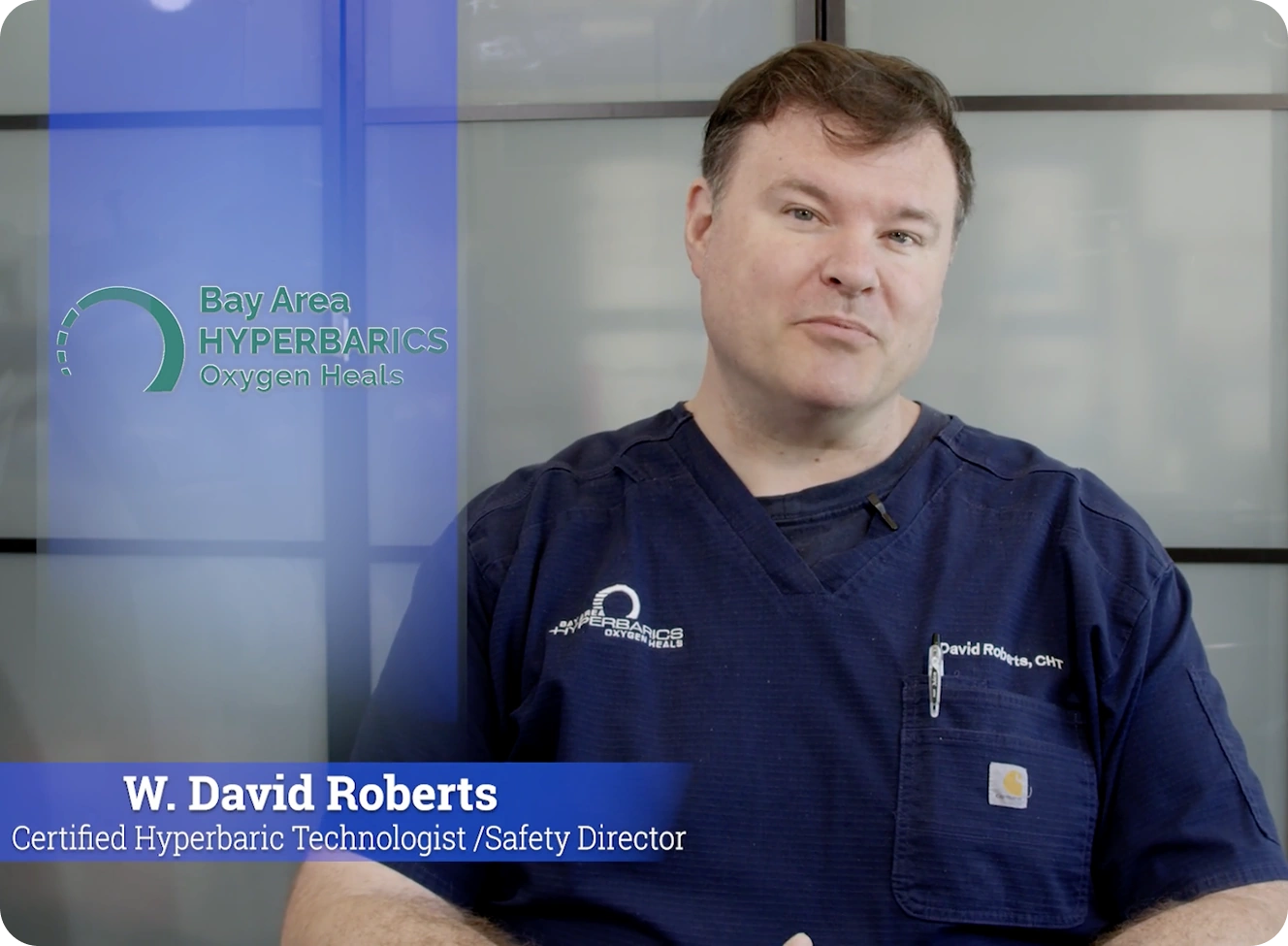
Watch W. David Roberts

Clinical team & training standards

Our people

Safe hyperbaric care begins with the people in the room. Our credentialing requirements go well beyond what most facilities consider adequate — because we believe patients deserve more than minimum standards.

Medical Director trained in hyperbaric medicine

Our Medical Director holds specialized training in hyperbaric medicine and provides clinical oversight of all treatment protocols and patient care decisions.

Nurse Practitioner onsite during every treatment

A Nurse Practitioner supervised by our Medical Director is present on-site throughout all patient treatments — not on call, not nearby, but in the clinic. Medical oversight is immediate.

Certified Hyperbaric Technologist on every shift

Every shift is staffed by at least one Certified Hyperbaric Technologist (CHT) — the highest professional credential in the field, awarded by the National Board of Diving and Hyperbaric Medical Technology.

EMT-certified technicians

Every hyperbaric technician holds Emergency Medical Technician (EMT) certification. In the unlikely event of a medical emergency, our staff is trained and equipped to respond — not waiting for outside help to arrive.

Minimum 40 hours of accredited training

All technicians complete at least 40 hours of formal hyperbaric training through accredited courses before working at our clinic. This is not a weekend course, and it is not delivered by a chamber salesperson.

One month of supervised in-house training

Before any technician treats a patient independently, they complete over a month of supervised, hands-on clinical training within our facility. They learn our protocols, our equipment, and our standards — not a generic checklist.

Our protocols

Clinical credentials alone are not enough. Safe outcomes require disciplined, consistently applied operating protocols — reviewed regularly and never treated as a formality.

Quarterly safety protocol reviews

Our Safety Director conducts a formal review of all safety protocols with every hyperbaric technician every quarter — not annually, not when something goes wrong.

100% cotton clothing for all patients

All patients are required to change into 100% cotton clothing before entering the chamber. Synthetic fabrics can generate static electricity, which poses a risk in an oxygen-enriched environment.

Grounding straps on every patient

We use grounding straps with every patient to eliminate the risk of static electricity near oxygen delivery equipment. This is a standard-of-care requirement we take seriously.

Strict no-outside-items policy

No personal items enter the chamber unless explicitly approved by clinical staff — including electronics, lotions, cosmetics, and accessories. Approved items such as water bottles are inspected before entry.

Continuous patient monitoring

A hyperbaric technician maintains direct visual monitoring of each patient throughout every treatment. Technicians are trained in emergency response protocols specific to hyperbaric environments.

Fire marshal and code compliance

Our clinic was constructed and is maintained in full compliance with local fire marshal requirements and all applicable safety codes governing hyperbaric facilities.

Our equipment

The chamber you treat in and the oxygen delivery method used are not interchangeable details — they are the foundation of both your safety and the effectiveness of your treatment. We made deliberate choices in both.

FDA-approved monoplace chambers

We treat patients exclusively in FDA-approved, hard-sided monoplace chambers. Our chamber manufacturer has been in operation for 40 years without a single accident attributable to their equipment.

Air-pressurized chambers — not oxygen-filled

We pressurize our chambers with air, not oxygen. The patient receives 100% oxygen through a non-rebreather mask. This is a critical safety distinction — an oxygen-filled chamber creates a far greater combustion risk than an air-pressurized one.

Liquid oxygen converted to gas

We use liquid oxygen converted to medical-grade gas, delivered to the patient via mask. This ensures a consistent, verifiable 100% oxygen concentration throughout every treatment.

No oxygen concentrators

We do not use oxygen concentrators. Concentrators used at some facilities cannot reliably deliver 100% oxygen at therapeutic pressures — typical output drops to approximately 80% at 2.0 ATA or above, compromising both safety and efficacy.

Treatments at 1.5 to 2.5 ATA

We treat patients within the clinically validated pressure range of 1.5 to 2.5 ATA — consistent with UHMS guidelines and hospital-based hyperbaric programs. Soft-sided chambers used at some clinics cannot safely reach or maintain these pressures.

UHMS and standards-body compliance

All of our equipment, staffing, and clinical procedures comply with the standards established by the Undersea and Hyperbaric Medical Society (UHMS) and other recognized standards bodies. This is why we are certified to bill insurance and Medicare — most other independent clinics are not.

Our commitment

Safety is how we respect every patient who walks through our door.

Hyperbaric oxygen therapy is an extraordinary treatment. It can heal conditions that conventional medicine cannot. But it must be practiced correctly, in the right equipment, by properly credentialed people, following rigorous protocols — every time, with every patient.

That is what we do. It is what we have done for 26 years. And it is why, when patients ask us whether HBOT is safe, our answer is simple: at Bay Area Hyperbarics, it is.

If you have questions about our safety practices, our staff credentials, or what to expect during your treatment, our team is available Monday–Friday, 8 am–5 pm. We welcome every question.

Schedule a free phone consultation

Talk with our team about your diagnosis, what to expect during treatment, and any safety questions you have — at no charge.

Laptops
YourCompany Logo

TREATMENT HOURS

Mon-Fri: 5:30 am – 8:00 pm

Sat & Sun: 8:00 am – 2:30 pm

BILLING HOURS

Mon-Fri: 9:00 am – 4:00 pm

NEW PATIENTS

Mon-Fri: 8:00 am – 5:00 pm

© 2026 | All rights reserved